60 plate year: September 2010 to February 2011
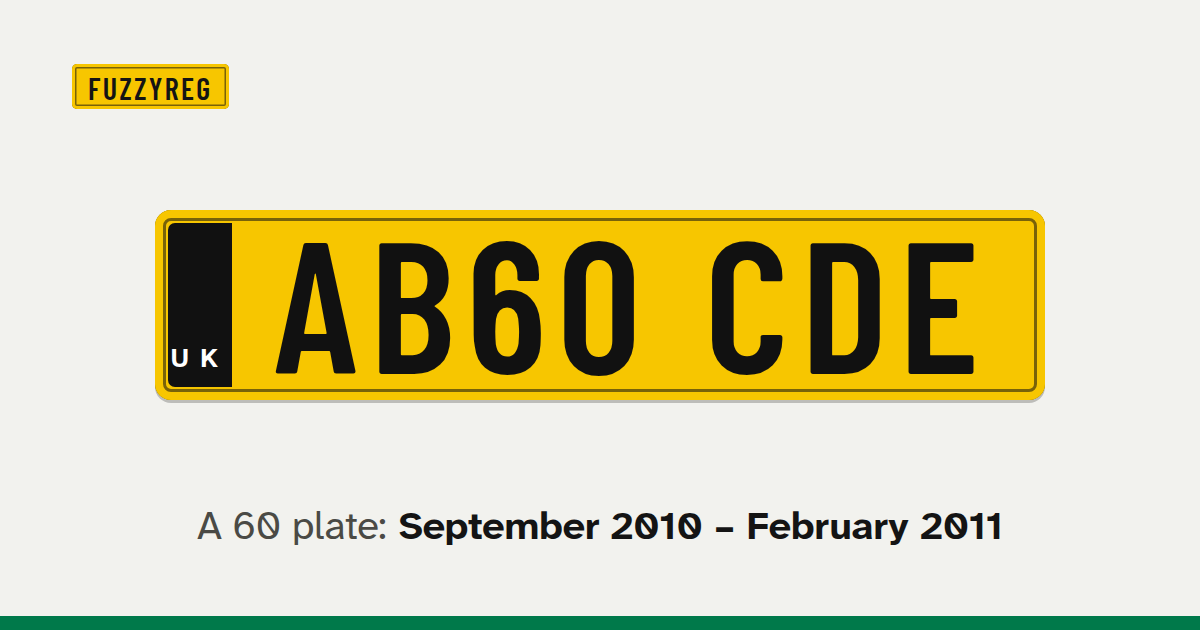
A 60 plate was issued between 1 September 2010 and the end of February 2011. That is a six-month window, not a year. UK identifiers change every March and September. The DVSA MOT record published on 1 November 2026 holds 1,071,016 vehicles wearing one.
The window
| Issued from | 1 September 2010 |
|---|---|
| Issued until | the end of February 2011 |
| Half-year | The September issue |
| Came after | the 10 plate |
| Replaced by | the 11 plate |
On the plate it sits in the middle: two letters, then
60, then three more letters, as in AB60 CDE.
The first two letters are the
DVLA area code, which
says where the mark was issued. The last three are random and carry
nothing at all.
Why 60 and not the year itself
A September identifier is the year plus 50, so 60 is the September 2010 issue, which is why it runs past the new year and ends at the end of February 2011. The full chart has every identifier in the scheme, along with the prefix and suffix styles that came before 2001.
What is on a 60 plate
The DVSA MOT record published on 1 November 2026 holds 1,071,016 vehicles on a 60 plate. On that date 52% had a valid MOT, 42% had let it lapse and 6% had no test on record. By fuel: petrol 45%, diesel 53%, hybrid 1% and electric 1%.
| Make | Vehicles | Share |
|---|---|---|
| Ford | 153,379 | 14% |
| Vauxhall | 126,399 | 12% |
| Volkswagen | 87,356 | 8% |
| BMW | 55,199 | 5% |
| Peugeot | 54,938 | 5% |
| Renault | 47,472 | 4% |
| Mercedes-Benz | 45,282 | 4% |
| Nissan | 44,686 | 4% |
| Toyota | 42,275 | 4% |
| Citroen | 42,161 | 4% |
By colour: black 22%, silver 18%, white 18%, blue 14%, grey 13% and red 9%.
Every make and colour above is a search, and an age identifier is
enough to search on its own: it pins two characters of the mark, the
same as typing ??60???. Each result comes with its
make, model, colour, fuel and latest MOT status.
Common questions
What year is a 60 plate?
A 60 plate was issued between 1 September 2010 and the end of February 2011. Identifiers change twice a year, so a 60 plate names that six-month window rather than a whole year.
When did the 60 plate come out?
The 60 plate came out on 1 September 2010. UK identifiers change on 1 March and 1 September each year, and this one was issued to new vehicles until the end of February 2011. The 11 plate followed it.
Can you get a 60 plate now?
New vehicles were given the 60 identifier only while it was being issued, between 1 September 2010 and the end of February 2011. You can still buy a 60 plate on a used vehicle, and a private mark can be transferred at any time, but a mark cannot be made newer than the vehicle wearing it.
Is a 10 or a 60 plate newer?
The 60 plate is newer, by six months. A September identifier is the March one plus 50, so both belong to the same year: 10 was issued from 1 March 2010 and 60 from 1 September 2010.
What is a 60 number plate?
It is an ordinary current-style UK registration whose two middle digits are 60: two letters, two digits, three letters, as in AB60 CDE. The first two letters are the DVLA area code and the 60 is the age identifier; the last three letters carry nothing.
How old is a 60 plate car?
It was first registered between 1 September 2010 and the end of February 2011, so count from there. The plate dates the registration rather than the build, and a car built shortly before a changeover is normally sold on the newer identifier.
What cars are on a 60 plate?
On the DVSA MOT record published on 1 November 2026, 1,071,016 vehicles wore a 60 plate. The commonest makes were Ford, Vauxhall and Volkswagen, and the commonest colours black, silver and white.
Either side of it
- 10 plate year: the half-year before
- 11 plate year: the half-year after
- Every identifier, with the months it covers
- What the first two letters mean
An age identifier is enough to search on its own.