73 plate year: September 2023 to February 2024
A 73 plate was issued between 1 September 2023 and the end of February 2024. That is a six-month window, not a year. UK identifiers change every March and September. The DVSA MOT record published on 1 November 2026 holds 1,055,043 vehicles wearing one.
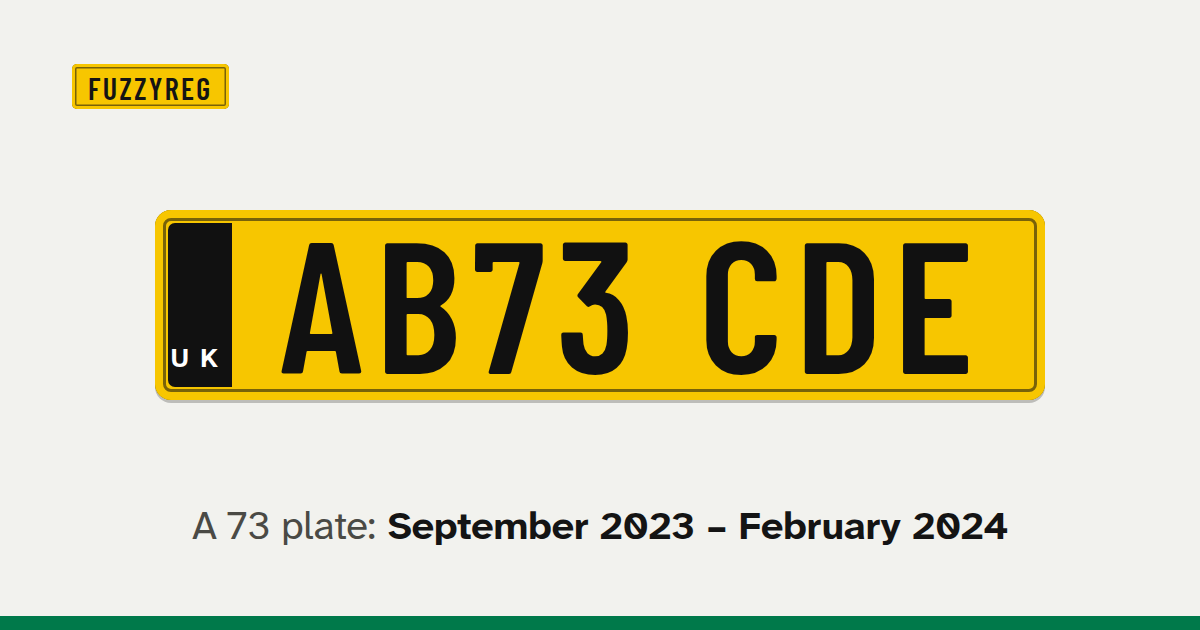
The window
| Issued from | 1 September 2023 |
|---|---|
| Issued until | the end of February 2024 |
| Half-year | The September issue |
| Came after | the 23 plate |
| Replaced by | the 24 plate |
On the plate it sits in the middle: two letters, then
73, then three more letters, as in AB73 CDE.
The first two letters are the
DVLA area code, which
says where the mark was issued. The last three are random and carry
nothing at all.
Why 73 and not the year itself
A September identifier is the year plus 50, so 73 is the September 2023 issue, which is why it runs past the new year and ends at the end of February 2024. The full chart has every identifier in the scheme, along with the prefix and suffix styles that came before 2001.
What is on a 73 plate
The DVSA MOT record published on 1 November 2026 holds 1,055,043 vehicles on a 73 plate. On that date 7% had a valid MOT, under 1% had let it lapse and 93% had no test on record. By fuel: petrol 37%, diesel 21%, hybrid 27% and electric 15%.
| Make | Vehicles | Share |
|---|---|---|
| Ford | 105,712 | 10% |
| Volkswagen | 85,384 | 8% |
| Vauxhall | 62,827 | 6% |
| Toyota | 55,389 | 5% |
| Audi | 54,878 | 5% |
| BMW | 51,099 | 5% |
| Mercedes-Benz | 47,868 | 5% |
| Nissan | 46,902 | 4% |
| Kia | 43,925 | 4% |
| Peugeot | 42,582 | 4% |
By colour: grey 25%, white 24%, black 18%, blue 13%, red 7% and silver 6%.
Every make and colour above is a search, and an age identifier is
enough to search on its own: it pins two characters of the mark, the
same as typing ??73???. Each result comes with its
make, model, colour, fuel and latest MOT status.
Common questions
What year is a 73 plate?
A 73 plate was issued between 1 September 2023 and the end of February 2024. Identifiers change twice a year, so a 73 plate names that six-month window rather than a whole year.
When did the 73 plate come out?
The 73 plate came out on 1 September 2023. UK identifiers change on 1 March and 1 September each year, and this one was issued to new vehicles until the end of February 2024. The 24 plate followed it.
Can you get a 73 plate now?
New vehicles were given the 73 identifier only while it was being issued, between 1 September 2023 and the end of February 2024. You can still buy a 73 plate on a used vehicle, and a private mark can be transferred at any time, but a mark cannot be made newer than the vehicle wearing it.
Is a 23 or a 73 plate newer?
The 73 plate is newer, by six months. A September identifier is the March one plus 50, so both belong to the same year: 23 was issued from 1 March 2023 and 73 from 1 September 2023.
What is a 73 number plate?
It is an ordinary current-style UK registration whose two middle digits are 73: two letters, two digits, three letters, as in AB73 CDE. The first two letters are the DVLA area code and the 73 is the age identifier; the last three letters carry nothing.
How old is a 73 plate car?
It was first registered between 1 September 2023 and the end of February 2024, so count from there. The plate dates the registration rather than the build, and a car built shortly before a changeover is normally sold on the newer identifier.
What cars are on a 73 plate?
On the DVSA MOT record published on 1 November 2026, 1,055,043 vehicles wore a 73 plate. The commonest makes were Ford, Volkswagen and Vauxhall, and the commonest colours grey, white and black.
Either side of it
- 23 plate year: the half-year before
- 24 plate year: the half-year after
- Every identifier, with the months it covers
- What the first two letters mean
An age identifier is enough to search on its own.